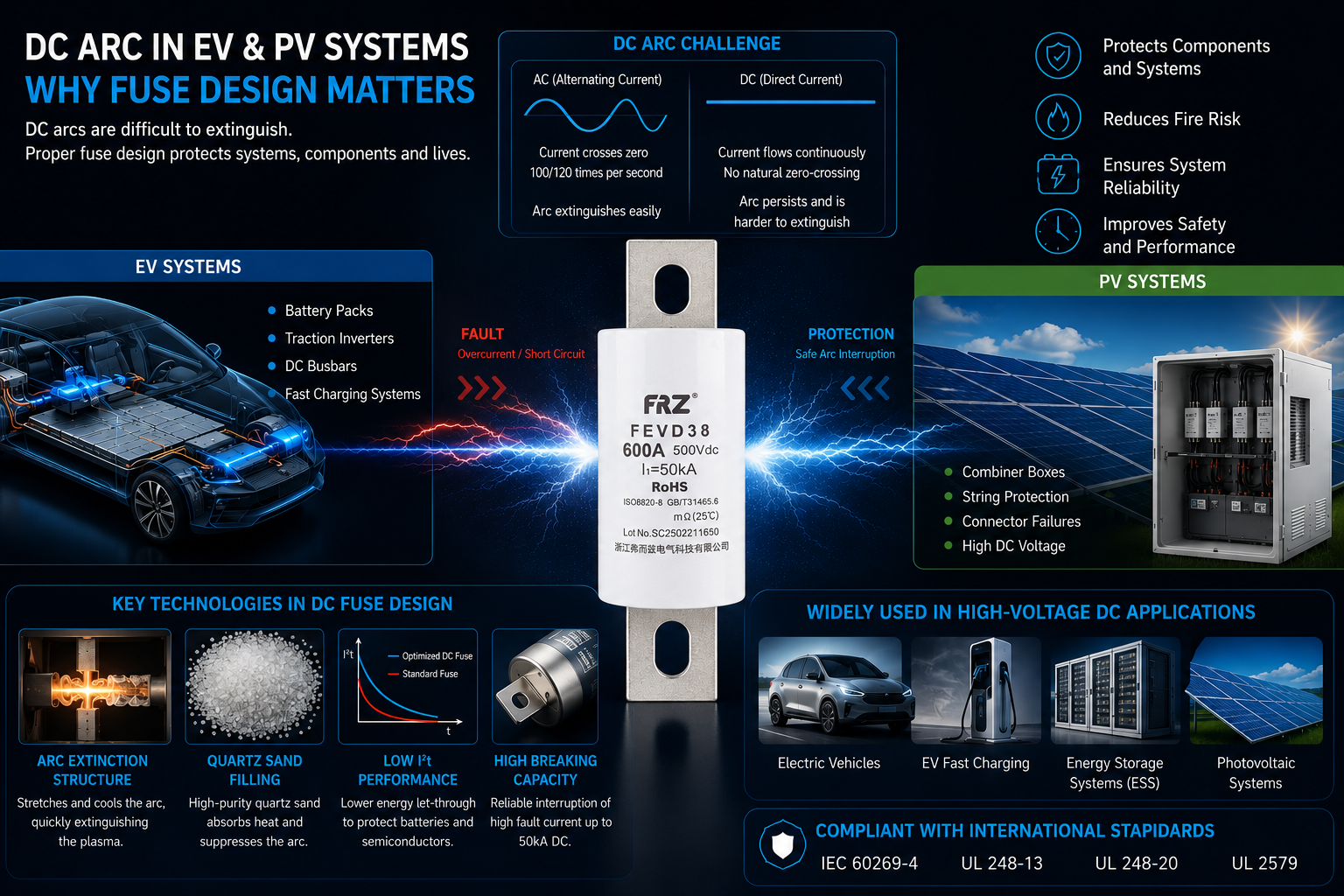
As industries rapidly move toward electrification, modern systems are increasingly relying on high-voltage DC power.
Typical applications include:
However, one of the biggest technical challenges in DC systems is arc interruption.
Compared with AC systems, DC arcs are significantly more difficult to extinguish, making proper fuse design critical for safety and reliability.
Caption: High-voltage DC fuse used for safe arc interruption in EV and PV applications
A DC arc is a continuous electrical discharge that occurs when current flows across an air gap after circuit interruption.
Unlike AC current, DC current does not naturally pass through zero.
This means:
Without proper protection, DC arcs may cause:
In AC systems:
In DC systems:
As voltage increases from:
the difficulty of interruption increases significantly.
DC arcs may occur in:
High-energy battery systems can generate severe fault conditions.
In photovoltaic systems, arcs may occur due to:
Modern 1500V PV systems create higher arc interruption challenges than earlier 1000V systems.
DC fuse design is far more complex than standard AC fuse design.
A properly designed DC fuse must:
Modern DC fuses use specialized internal structures to:
This helps extinguish the arc quickly.
Many high-voltage DC fuses use:
The sand absorbs heat and helps suppress arc plasma during interruption.
Low I²t performance is critical for:
Lower energy let-through reduces thermal stress during faults.
Modern EV and PV systems may require:
High breaking capacity ensures safe fault clearing under severe conditions.
Traditional EV systems typically used:
Arc interruption requirements were moderate.
Modern EV platforms increasingly require:
Challenges include:
Utility-scale PV systems now commonly use:
These systems require:
Ultra-fast charging systems create additional challenges:
Reliable DC fuse protection is essential for:
As electrification expands, DC protection technology continues evolving toward:
DC arcs represent one of the most critical safety challenges in modern EV, PV, and energy storage systems.
As system voltage increases, reliable DC fuse design becomes increasingly important for:
Advanced DC fuse technology plays a key role in enabling the next generation of high-voltage electrification systems.
Why is DC arc interruption difficult?
Because DC current does not naturally cross zero like AC current.
Why are DC fuses different from AC fuses?
DC fuses require specialized arc suppression and interruption design.
What systems require DC arc protection?
EVs, PV systems, ESS systems, and fast charging infrastructure.
Why are higher voltage systems more challenging?
Higher voltage creates stronger and longer-lasting arc energy.

We use cookies to enhance your browsing experience, serve personalized ads or content, and analyze our traffic. By clicking "Accept All", you consent to our use of cookies.
 EN
EN ES
ES