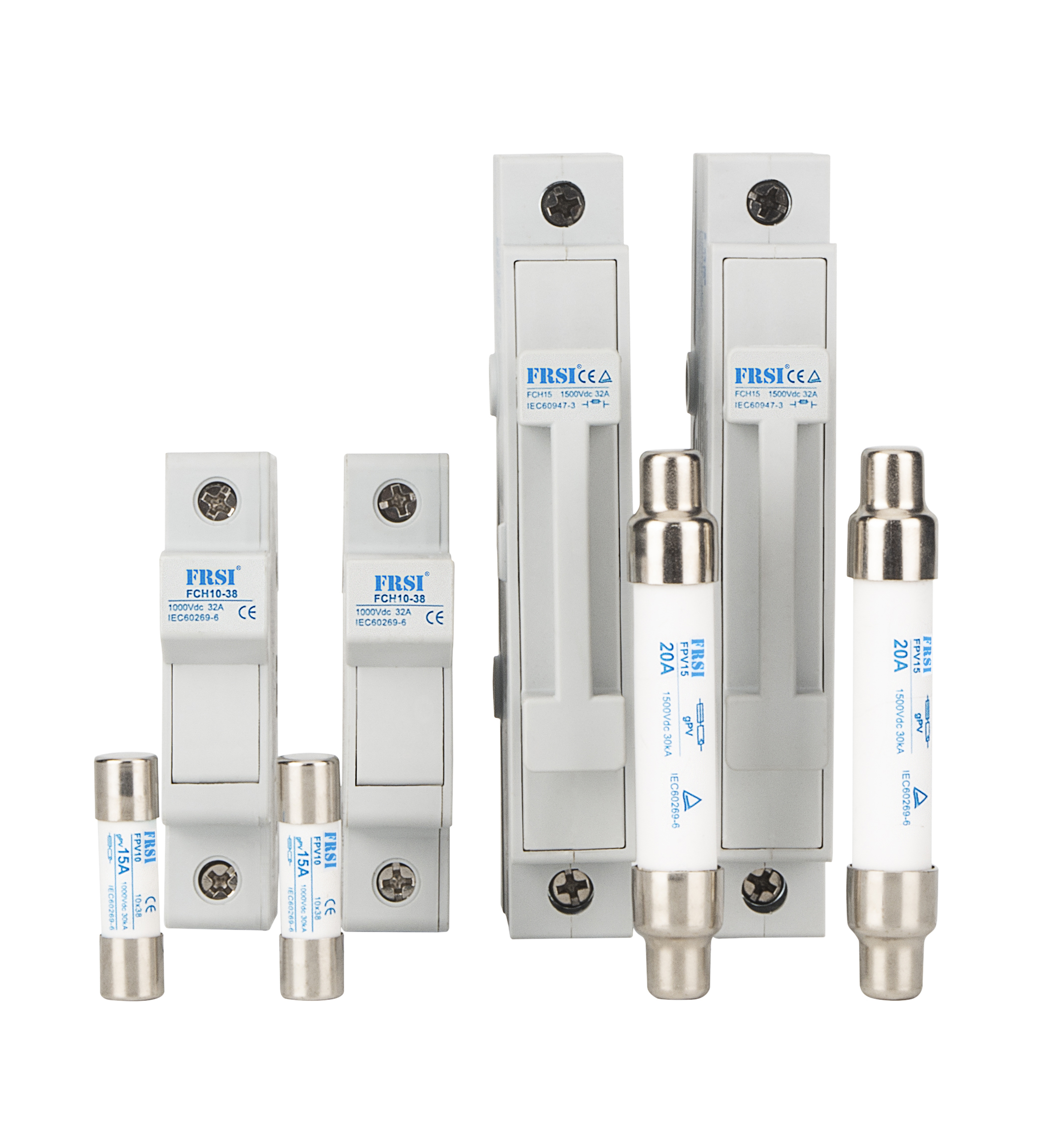
A PV fuse is a DC-rated protective device used in solar photovoltaic systems to protect cables, modules, and equipment from overcurrent and short-circuit faults.
Unlike general-purpose fuses, PV fuses are specifically designed for:
In PV systems, multiple strings are often connected in parallel. Under fault conditions, healthy strings can feed current into a faulty string.
This creates risks such as:
PV fuses are installed to interrupt these fault currents and protect system components.
PV fuses are commonly installed in:
Each application requires correct fuse sizing based on system design.
Modern PV systems operate at high DC voltages:
👉 The fuse voltage rating must be equal to or higher than system voltage.
PV fuse current is based on string current:
Ifuse≥1.25×IscI_{fuse} ≥ 1.25 × I_{sc}
Where:
PV systems can produce significant fault current.
Typical requirements:
PV systems require:
Lower I²t helps reduce damage during fault conditions.
PV systems typically use gPV fuses, which are specifically designed for photovoltaic applications.
Characteristics:
Key standards include:
These standards ensure safe operation in solar DC environments.
👉 Fuse:
10A×1.25=12.5A10A × 1.25 = 12.5A
👉 Select: 15A PV fuse
| Feature | PV Fuse | EV Fuse | ESS Fuse |
|---|---|---|---|
| Application | Solar systems | Vehicles | Energy storage |
| Voltage | up to 1500V | up to 1000V | up to 1500V |
| Current Type | Continuous | Dynamic | Mixed |
| Fuse Type | gPV | aR / gR | gR |
PV fuses play a critical role in protecting solar power systems from overcurrent and fault conditions.
Proper fuse selection ensures:
What is a PV fuse used for?
PV fuses protect solar panels, cables, and equipment from overcurrent and faults.
What is the difference between gPV and normal fuse?
gPV fuses are designed for solar DC systems with low fault currents and continuous operation.
How do I size a PV fuse?
Use 1.25× the short-circuit current (Isc) of the PV string.
What voltage are PV fuses rated for?
Common ratings include 1000V and 1500V DC.

We use cookies to enhance your browsing experience, serve personalized ads or content, and analyze our traffic. By clicking "Accept All", you consent to our use of cookies.
 EN
EN ES
ES